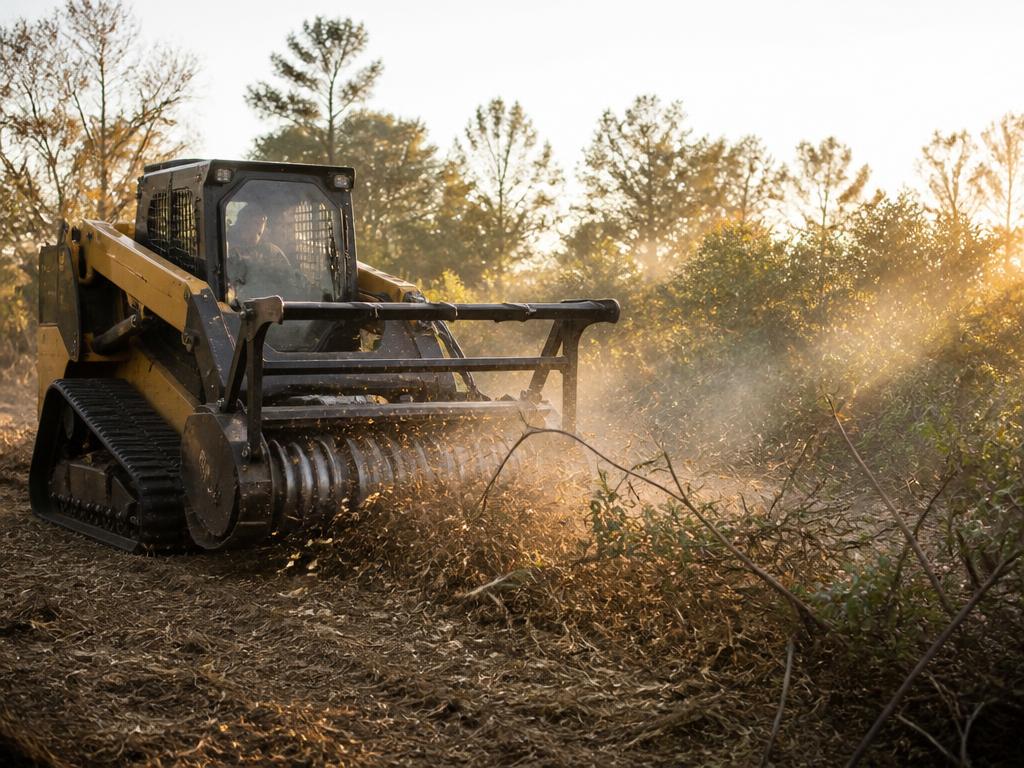
Forestry mulching clears standing vegetation and grinds it into mulch that stays on the ground where it came from. Instead of cutting, piling, loading, and hauling, the material is processed in place and spread as a layer of chip across the soil. For overgrown acreage, that difference usually means fewer machines, fewer truck loads, and a shorter job.
It works especially well on the kind of growth Northern California property owners deal with: dense brush, blackberry, broom, willow, tules along ditch banks, volunteer saplings, and years of unmanaged undergrowth beneath larger trees you want to keep. Because the machine works around what stays, you can open up a parcel without stripping it bare.
The mulch layer itself is useful. It shades bare soil, slows erosion on slopes and ditch banks, holds moisture through a Valley summer, and breaks down over time. It also suppresses regrowth for a while — not permanently, but long enough that maintenance becomes manageable rather than a full re-clear.
Forestry mulching is not the right answer for every job. Very large trees, stumps that must be removed, and sites that need bare graded soil are better handled by conventional clearing. When we walk your property we will tell you honestly which approach fits, and often the answer is a combination of the two.
Who needs forestry mulching
- Owners of overgrown acreage who do not want piles or burn permits
- Rural property owners managing recurring brush growth
- Landowners reducing fuel loads around structures and access roads
- Owners needing to open access to a back parcel, well, or ditch
- Buyers who just closed on a neglected property
- Ranch and orchard owners clearing perimeters and margins
Common project types
- Multi-acre brush clearing on rural Northern California parcels
- Understory clearing beneath oaks and mature trees
- Fence line, ditch bank, and levee-adjacent vegetation control
- Access road and driveway corridor clearing
- Fuel reduction around structures, barns, and outbuildings
- Recurring maintenance passes on previously mulched ground
How the process works
1. Assess the vegetation
We look at species, density, stem size, terrain, slope, and access to confirm mulching is the right tool for your property.
2. Mark what stays
Trees, plantings, irrigation, wells, and features you want protected get identified before any machine moves.
3. Free written estimate
Priced by the work in front of us — acreage, density, and terrain — with no charge for the assessment.
4. Mulch in place
Vegetation is cut and processed as we go, leaving a mulch layer instead of piles to deal with later.
5. Walk it and plan maintenance
We review the result with you and, if you want, set a realistic interval for a lighter maintenance pass.
Residential and commercial work
For rural residential properties, mulching is often the fastest way to make land usable again — opening sight lines, restoring access to outbuildings, and clearing the margins around a home site without leaving debris piles behind.
For commercial and agricultural landowners, mulching handles perimeters, easements, retention areas, and undeveloped parcels that need to stay maintained without a hauling operation on site.
Please note: Vegetation management can reduce available fuel around a property, but no clearing or mulching work makes any property fireproof or guarantees protection from wildfire. Follow your local fire agency's defensible-space guidance.
Where we work
Go Pro Works is based in Stockton and serves San Joaquin County and Northern California communities within roughly a three-hour drive — including Lodi, Manteca, Lathrop, Tracy, Ripon, Modesto, Turlock, Sacramento, Elk Grove and Galt. See the full Go Pro Works service area list.
- Forestry Mulching in Stockton
- Forestry Mulching in Lodi
- Forestry Mulching in Manteca
- Forestry Mulching in Tracy
- Forestry Mulching in Modesto
- Forestry Mulching in Sacramento